The Ingredients for Change Were Already Present
By Moises P. | Program and Data Manager
From fish tanks turned into nurseries to kitchen spices that defeat crop plagues, small-scale farmers in Guatemala are reclaiming food sovereignty, one garden at a time.
What does real change look like in a small farming community? Often, it looks like someone walking a hundred meters to a neighbor's carpentry trash pile to return with a bag of sawdust that will save their struggling garden.
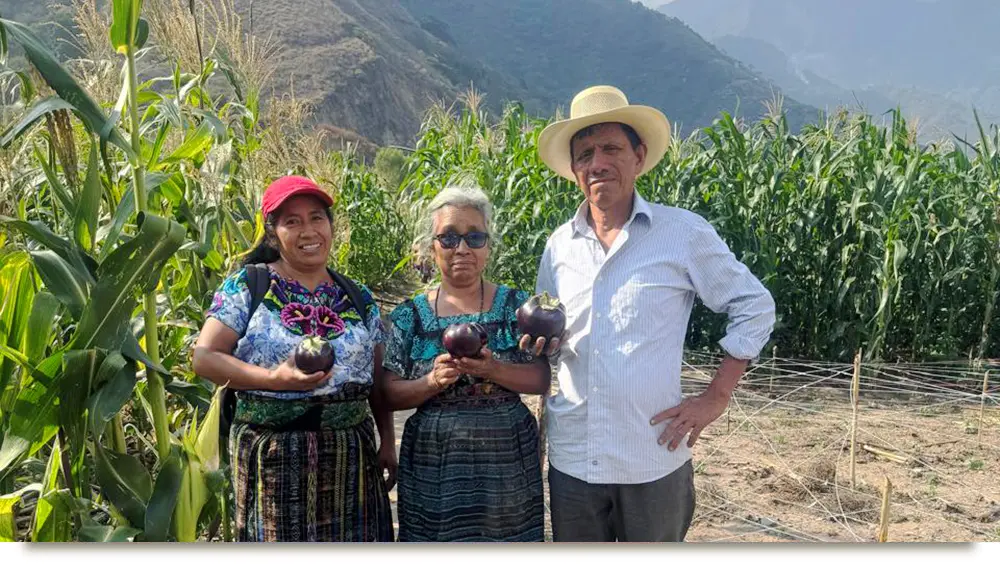
Over the last month of May, the Seeds for the Future field team traveled intentionally between communities across Guatemala's highlands and lowlands to visit families, deliver seedlings, and support progress. They also did something quieter and more important: they taught people to see the abundance already around them.
In two weeks, 1,563 seedlings were delivered, beginning the restoration of Program members’ family gardens. One beneficiary earned Q1,500 ($250 USD) from selling her fig harvest alone. Over a 6-week period, a family saved valuable time and money on market visits by growing and harvesting enough produce from their home garden. The most powerful interventions are those that reassemble what is already present in the soil, in the kitchen, or in the water.
Stories from the Field - Five Moments that Tell the Whole Story
The fish tank that became a greenhouse, Chocolá
When the team arrived at Doña Alejandra's home, her seedlings were struggling. The solution? They moved the seedlings, which were planted in styrofoam cups, into an unused fish tank. The water system kept the humidity steady. No equipment was purchased. The family now carries life-long knowledge that a fish tank can grow a garden.
The extensionists from Seeds for a Future are teaching that value is generated not through over-consumption, but through the creative reuse of what exists. The fish tank was not designed to grow seedlings. It became capable of doing so through a moment of lateral thinking. The sovereignty this represents is not just economic; it is epistemic. The family now knows that a fish tank can be a seedling nursery and how to replicate the process to produce more seedlings.
The carpenter's trash as medicine for the soil, Santa Bárbara
Doña María's plants were suffocating in compacted soil. A nearby carpentry shop was dumping bags of sawdust a hundred meters away. The team walked over, collected a sack, and showed her how to integrate it. A neighbor's waste, quietly discarded, became a gift. Nearby, another neighbor was disposing of cow manure in the same spot, and the fertility resource was treated as garbage because no one knew how to connect it to the people who needed it.
Jalapeño and garlic defeat a plague, Xejuyup & Pasac
When larvae were found in oyster mushroom growing bags, the team blended jalapeño chilis, garlic, and onion and applied the concentrate directly. Three days of treatment. By Thursday, the bags were clean. The moment was turned into a live training session, families and colleagues learning together how to identify the problem and act fast. Kitchen ingredients. Zero cost. No supply chain required.
The dependence on commercial veterinary inputs is one of the most consistent vulnerability factors for small-scale livestock producers. For a family without disposable income, a sick chicken can mean the loss of an animal and the loss of confidence in the whole ecosystem. To know that garlic and lemon can serve as prophylaxis is to hold a piece of infrastructure that requires no supply chain, no pharmacy, no credit. It is knowledge as sovereignty.
Life wastes nothing, Chocolá
Julieta, a program member from Solola, always had fruit trees. What changed was the intentionality of how they have been utilized. She began harvesting her figs, lemons, and peaches and selling the fruit, sweetened, at the local market. Within two weeks, she had earned Q1,500 ($200 USD). The trees were always there, but now the knowledge of how to use them more resourcefully made the difference.
"Each plant that grows is a quetzal that does not leave the household for the market. The economy being built here is not primarily one of profit; it is one of subtraction from dependency."
The bigger picture: Not charity. Subtraction from dependency.
The clearest sign that something is working is not income, it's the disappearance of a cost. When Gricelda Gudelia's family stopped buying tomatoes for six weeks, that money didn't appear in a revenue report. It simply stayed. When the communal garden in Patulul harvested cabbage and greens, the Q400 ($55 USD) in savings meant the family could redirect spending toward things they couldn't grow. Sugar. Rice. School supplies.
This is what food sovereignty looks like from the inside: not a dramatic transformation, but a quiet reduction in the number of things a family depends on strangers to provide. Every seedling planted is one less purchase to make. Every piece of local knowledge recovered, about garlic as pesticide, about sawdust as soil amendment, about a fish tank as a nursery, is a thread pulled back from a system that profits when people don't know what they could do for themselves.
"Collaborative survival" requires us to notice the world-making that happen in neglected spaces, forests, margins, and informal kitchens. This field report is, in that sense, an ethnography of exactly those spaces. This past month, the women who left training sessions each carrying seedlings of hierbamora, lettuce, bledo, tomato, and chili were not just receiving inputs. They were being inducted into a living, distributed, largely oral knowledge system — one that knows how to turn a styrofoam cup and a fish tank into a greenhouse, a kitchen pantry into a veterinary cabinet, and a bottle of water into a lifeline for the harvest.
Across two weeks, 1,563 seedlings reached families. Behind each one is a home visit, a conversation, a demonstration, a follow-up. The work is slow, relational, and deeply human, and it is exactly that slowness that makes it last.