
Why Permaculture Home Gardens Sustainably Overcome Chronic Malnutrition
By Dr. Jim Barlow, Agronomist, Soil Expert, and Seeds for a Future Board Advisor
Seeds for a Future is deeply committed to reducing chronic malnutrition among indigenous populations in Guatemala, with a special focus on pregnant women, infants, and young children.
While many programs focus on short-term aid to address chronic malnutrition and food insecurity, we focus on long-term training and critical start-up resources. The training and resources we provide enable families to build their own food security and improve their nutrition and health with knowledge and practices that will endure for generations.
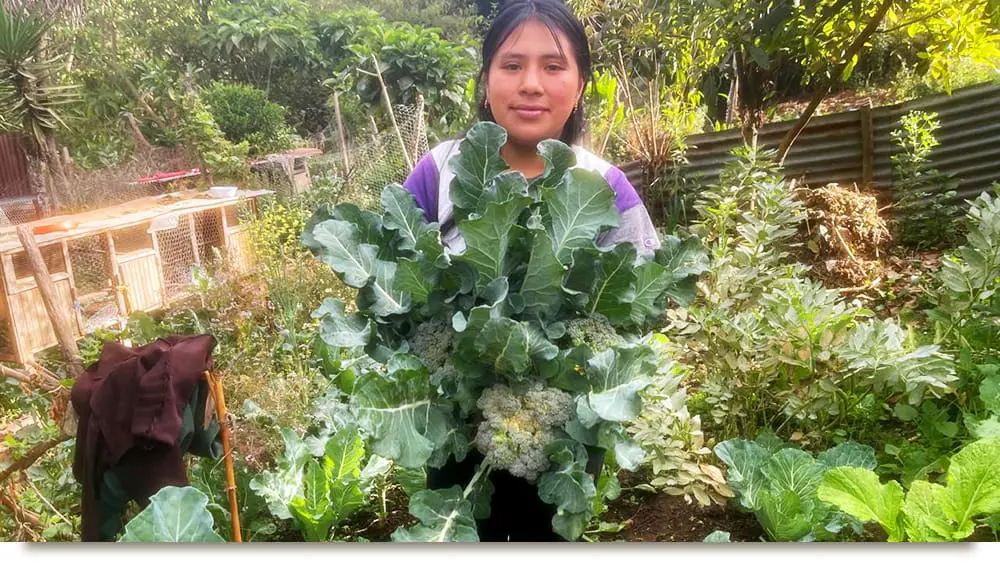
We incorporate a “bottom-up” model, also known as a “home-grown” model. Families are trained to establish and maintain regenerative, permaculture-based nutrition gardens around their dwellings to ensure food security under their direct control. Start-up resources for families include plant seedlings rich in protein, amino acids, vitamins, minerals, and healthy oils that have been missing from their diets, as well as materials needed to ensure the security of their growbeds.
Shared with families are the nutritional or medicinal value of each plant type and how to cook or incorporate them into traditional meals that the family will consume. Additionally, families are trained to raise chickens, ducks, turkeys, fish, and rabbits for extra animal protein that may otherwise be unavailable or expensive to purchase. We also teach nutrition science, so they gain vocabulary and knowledge that will serve them forever.
The Nutrition Garden Model
The nutrition garden model is time-proven to work well. However, difficulties can arise when families lack essential gardening skills, resulting in lackluster gardens with poor growth and low nutrient density. A key to the success of our program is that our field team members who visit and teach our participating families are all trained by the senior field team members. Our senior members are walking encyclopedias of plants, nutrition, garden design, soil health, and how to achieve vigorous, abundant growth. With this knowledge and training, families develop an eye for plant vitality and a green thumb for yielding a basket of fresh garden produce for each meal.
Beyond providing a diverse mix of nutrition, the garden produce must be free of toxic pesticide residues, especially for infants and small children. Their gardens are organic, but with bugs and plant diseases abound. So, how do we teach our Program member families to protect their garden plants? What practices do we use to detect or prevent pests and diseases so we can be organic?
Permaculture and Regenerative Practices
You may have heard the terms “regenerative agriculture” or “permaculture”. These are catch terms for related approaches to organic farming and gardening that harmonize with Nature. Both systems model how complex ecosystems, such as prairie grasslands and old-growth forests, remain in balance through biological processes that protect plants on the one hand and renew soil fertility on the other, all without human intervention.
Regenerative practices use methods that bring overworked, degraded soils back toward a virgin state with each crop cycle. The main goal is to maintain high biomass and diversity of active soil biota, such as beneficial fungi, bacteria, and worms, that can form symbiotic relationships with the roots of garden plants. Some of these beneficials will feed on the species that cause root rot diseases. Others will release bound-up nutrients, making the soil more fertile without the need for applied fertilizers, while some species will synthesize the humus that makes soils dark, of good tilth, and able to retain moisture.
Permaculture is a sustainable gardening system for modeling the stable, productive ecosystem dynamics of complex lands. It is the opposite of monocropping. With permaculture methods, many species live in a mixed planting (intercropping) where the diverse species help and are helped by each other.
Permaculture Works in Three Dimensions
Some plants grow the tallest and provide shade for understory plants, as coffee does best in the partial shade of taller trees. Then there are ground-cover plants that will grow on the surface. Other plants are root species that produce roots at lower soil levels. This layering still leaves room for climbers, such as vines that climb the vertical trunks of upper-story trees and shrubs. Then there are animals like birds, deer, rodents, and fish that circulate nutrients throughout the system, making the whole a poetry of self-regulating, self-healing growth and recycling.
Permaculture enthusiasts mostly plant food forests where fruit and nut trees are the tallest, with medicinal shrubs and berries below, and root vegetables in the ground with their vines climbing up trunks and branches for support. Into this designed planting, there can be chickens, ducks, geese, and turkeys to eat bugs and young weeds, and enrich the soil. The diverse plants and animals support and protect one another. The Permaculture site becomes a food forest where one can stroll through and pick what fruits, nuts, vegetables, herbs, and medicinals are in season.
Where space allows, around the dwellings of our program members, we help them establish gardens and plantings using the Permaculture model. Even if space only allows for a raised bed without fruit trees or shrubs, we still follow the three-dimensional model. We companion-plant many types of plants that help each other. For example, we plant beans that will climb the corn stalks, while planting sweet potatoes or yams, whose vines will serve as ground cover under kale, broccoli, and eggplant that grow above in the same space. Often, program participants' chickens, ducks, geese, or turkeys will forage in the garden. When there are pest bugs, we use a natural garlic, chili, and soap spray that does the job. Where there is room, we help our families plant fruit and avocado trees to diversify the diet beyond annual garden plants.
Permaculture also integrates supporting systems such as rainwater collection to feed irrigation during the dry season and composting to transition natural dry waste into nutrient-dense fertilizers. Both of these systems are integrated at homes where able, taught, and mentored by our skilled field team members.
Nutrition and Food Security Outcomes
With the right knowledge of where to place garden beds, fruit trees, and animal hutches, the small spaces around a modest dwelling can become sustainable, nutritious gardens where there were none before. Previously, and likely under economic constraints, the family may have been living on a diet of processed foods and soda drinks, leading to the chronic malnutrition that was physically and mentally stunting their children. The family was forced to buy only what food they could afford, which was too often not enough for even basic caloric intake.
When our families transition to becoming skilled gardeners who produce nutritious, home-grown food, they don’t have to purchase unhealthy processed foods and often have a surplus to sell. They step up to become self-reliant and take control of their food security.
Parents see their children now well-nourished and able to do well in school, with a better future. It all comes down to seeds, where they can be planted and how they tend to change the future for those families. Seeds for a Future provides a path to clean, organic food that families and communities can grow themselves, while passing along their food-growing traditions to future generations.