When Intuition Meets Crisis with a Proven Solution
By Vivian Varga - 05/06/2026
In the volcano-side community of Chocolá, Guatemala, something began to disintegrate one family’s mushroom harvest, before something remarkable happened.
As many program members cultivate mushrooms as a source of protein and income, a relationship between the health of their crop and the success of their yields begins to form. One mother noticed it first: something subtle in the texture of the oyster mushrooms she'd been tending was changing, and she was not sure why. She mentioned the issue to her local Seeds for the Future Extensionist, Don Julio, who immediately investigated the cause.
Together, they identified an emerging plague early enough to stop it from spreading or impacting her mushroom harvest by applying garlic and local herbs as an organic pesticide. In the neighboring community of Guineales, another woman did the same.
These stories are not uncommon for families in our program. Thankfully, our team builds strong communication with program members, and a deep trust develops, turning these conversations about potential failures into learning opportunities vital to success. These instances are prime examples of what happens when someone genuinely cares for other living things; when observation and relationship replace a checklist.
Roots of Success: Seedlings and Growth
Access to pilones (seedlings) remains a significant and persistent challenge for rural smallholder farmers in Guatemala. Rural Indigenous Guatemalans face the highest rates of chronic malnutrition in Central America, and most families in communities like Chocolá survive on just $3 per day, according to the World Bank Group. In this context, the ability to access quality seedlings, whether by purchasing them, program distribution, or self-production, is a meaningful determinant of food security outcomes.
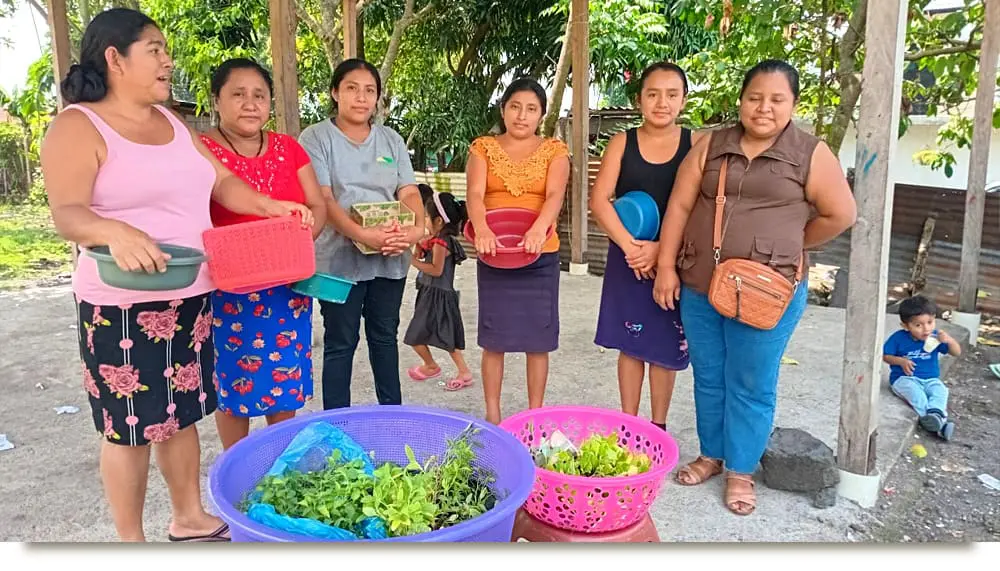
In Chocola alone, where our team has established piloneras (seedling houses), seedling production more than doubled in the first half of March, from 710 units to over 1,500 by mid-month. By the end of March, more than 500 seedlings had been distributed to families for their individual gardens, and over 3,000 were ready for transplantation. Each new family requires anywhere from 50 to hundreds of seedlings to start or replenish their regenerative home gardens.
By bringing seed harvesting in-house, our team provides vital resources to families while learning new skills, reducing input costs, and saving hundreds of dollars each month, better equipping us to more effectively meet the needs of those we serve.
New Families, Early Results
Families who recently joined our program, each with between 2 and 7 members in their household, are already reporting positive results. Participants consistently say they value the accompaniment most: they are not given seeds and left to learn how to succeed on their own. They are supported by our team of extensionists throughout each phase of their growth and in real time. For new families, that presence makes all the difference.
One program member came to our team to share their concern about a persistent skin condition. Through shared knowledge, the member learned about a local plant called tres puntas (Herbertia lahue), whose medicinal properties are well known in the region. After witnessing the healing and improvement, several other families have added it to their gardens. In another community, participants learned to use produce from their own gardens to make green juices that help manage high blood pressure.
This cross-pollination of knowledge from family to family, community to community, is one of the most quietly powerful aspects of our network.
Expanding What We Know
Our field team members don't just share knowledge; they are life-long learners. In March, they participated in training on early childhood nutrition, focused on breastfeeding support and complementary feeding for mothers and infants. They also learned the Lucky Iron Fish technique, a simple, well-documented tool developed by Canadian health workers in Cambodia that adds iron to cooking water, helping combat anemia in communities where iron deficiency is common.
Likewise, in early March, Program Advisor and agronomist Dr. Jim Barlow joined the team in the field to teach them how to measure pH, conductivity, and mineral content in local water sources, which will now be an added skill set they can use to stay ahead of the curve. Understanding water and soil quality is the first step to feeding the land well and nurturing an ideal home for the regenerative gardens of our families.
Why We Do This
With the right knowledge of where to place garden beds, fruit trees, and animal hutches, the small spaces around a modest dwelling can become sustainable, nutritious gardens where there were none before. Previously, and likely under economic constraints, the family may have been living on a diet of processed foods and soda drinks, leading to the chronic malnutrition that was physically and mentally stunting their children. The family was forced to buy only what food they could afford, which was too often not enough for even basic caloric intake.
When our families transition to becoming skilled gardeners who produce nutritious, home-grown food, they don’t have to purchase unhealthy processed foods and often have a surplus to sell. They step up to become self-reliant and take control of their food security.
Parents see their children now well-nourished and able to do well in school, with a better future. It all comes down to seeds, where they can be planted and how they tend to change the future for those families. Seeds for a Future provides a path to clean, organic food that families and communities can grow themselves, while passing along their food-growing traditions to future generations.
Join us
You can help sustain a family's participation in the program for a full year — including regular visits, training, seedlings, and the kind of accompaniment that makes the difference between a good intention and a transformed garden.
We hope you'll consider joining us in supporting communities transitioning through empowering food security and nutrition solutions.
SFAF has been working in the Guatemalan highlands since 2009. Our integrated home garden program supports families in Chocola, Guineales, Patulul, and surrounding communities through field team member-led accompaniment, training, and technical support.